Tuesday, April 06, 2010

ROUTE 29: Errant Signs Still Up at Dupont, But Can They Be Reused at Key Bridge?

IT’S NOW BEEN MORE THAN THREE WEEKS since I started a test of the D.C. government’s social media responsiveness regarding what should be a relatively easy task: Removing incorrect signage from Dupont Circle that suggests Route 29 heads through the District via New Hampshire Avenue.

The signs were still posted as of this morning. (But I did see a DDOT truck full of signs parked on Wisconsin Avenue in Tenleytown earlier today, so maybe it was en route to deal with my request?)

As I detailed recently on this blog (and in a January 2005 blog post when I was editing DCist), Route 29 was rerouted years ago, via 11th Street NW and Rhode Island and Georgia avenues. The incorrect signage has been at Dupont Circle for years, so I realize that it’s not the most pressing problem for the District Department of Transportation, which has had a busy winter dealing with blizzards and a subsequent pothole-filling blitz, aided by Twitter. (DDOT was also busy at Nationals Park on Monday with Opening Day.)

I’ll tweet @DDOTDC to check in on my request to remove the incorrect signs and update. (Another quick response, via direct message: @DDOTDC hasn't forgotten about my request, it's just there hasn't been time yet to get them taken down. C'est la vie.) Since the initial tweet request on March 14, the agency acknowledged my request, responded to a second tweet inquiry and confirmed via subsequent direct messages that Route 29 doesn’t run through Dupont Circle. Additionally, @DDOTDC asked me where the signs were located. I responded that there are at least four Route 29 signs if you walk around the circle. (Hey DDOT: I recently spotted a fifth, on New Hampshire Avenue, south of the circle, on the sidewalk adjacent to the northbound lanes and the Heurich House.)

So, What About the Key Bridge/Whitehurst Signs?

It would a shame to just trash the old Dupont signs. Here’s a suggestion: Reuse them for the Route 29 connection between the Key Bridge and Whitehurst Freeway.

Just like I noted in January 2005, northbound Route 29 today lacks any sort of signage on the Key Bridge to alert drivers to the connecting ramp to the Whitehurst Freeway, where Route 29 continues en route to K Street NW and downtown. (At the photo above, note the small hard-to-see sign that says “To Downtown,” which lacks any sort of arrow indicating which way you’re supposed to go.)

Similarly, wayfinding signage for southbound Route 29 is problematic. There are no Route 29 signs if you’re going from the Whitehurst onto the Key Bridge, via the bridge’s congested intersection with Canal Road and M Street NW. In the traffic island, there’s a big empty signpost just sitting there (see photo below left), suggesting the city once had plans to place wayfinding signage there for Canal Road/MacArthur Boulevard/Foxhall Road and another for Key Bridge and M Street NW (and southbound Route 29, of course).

Are U.S. Highway Route Signage Important?

Drivers in the District don’t find much use for U.S. highway routes, which predate the Interstate Highway System. The routes, designated with black lettering on a white shield, are more identified with roadways in Maryland and Virginia. Long-distance drivers generally stick to the Interstate highways and don’t need to rely on Routes 1, 29 and 50 to get move through the D.C. metro area. But they might take one of those routes through the Maryland and Virginia suburbs, though they’re often known better by local names, like Lee Highway (Route 29) or Arlington Boulevard (Route 50) in Virginia and Colesville Road (Route 29) in Maryland.

In recent years, the city replaced aging and ineffective route wayfinding signage on the inbound 14th Street Bridge. The bridge technically carries Interstate 395 and Route 1 between the District and Virginia. As drivers approached the 14th Street SW/Southwest Freeway split adjacent to the Jefferson Memorial, the overhead sign simply gave you two highway shields to choose from: Route 1 and Interstate 395. When the sign was rehabbed a few years ago, additional information was added to note that Route 1 runs into downtown via 14th Street, which is more useful designation for local drivers.

Now, will the District clear up the Route 29 confusion? (I just tweeted @DDOTDC about possibly reusing the signs.)

Labels: , , , , , ,

Thursday, March 25, 2010

CAPITOL SOUTH: Train Tunnel Would Complicate 'Pelosi House Office Building'


MATT YGLESIAS IS RIGHT: The surface parking lot to the south of the Cannon House Office Building and adjacent to the Capitol South Metrorail station escalators is pretty ugly, a space that could be used for more productive purposes. The ThinkProgress blogger wrote earlier this week that the space is perfect as "the future location of the Pelosi House Office Building."

But the construction of congressional office buildings has been a political hot potato for generations — for more background on the evolution of the congressional campus, see my article "The Keystone of Washington" from Roll Call's 50th Anniversary edition in 2005 and my piece about the construction of the Hart Senate Office Building from 2004.

For any future Pelosi House Office Building, the security challenges posted by First Street's train tunnel would complicate construction.

The tunnel that links Union Station's lower level train platforms — for Virginia Rail Express and Amtrak service serving points south of Washington — with L'Enfant Plaza and the Long Bridge over the Potomac River beyond curves directly under the parking lot where Yglesias would like to see an office building honoring the House speaker. You can see the tunnel portal here near New Jersey Avenue; at First and C streets SE, the tunnel curves north on its route to Union Station. Another Capitol Hill-area tunnel, under Virginia Avenue, sits nearby and provides a bypass of the First Street tunnel and Union Station for trains traveling between Virginia and Maryland.

Following the toxic Howard Street train tunnel fire in Baltimore in 2001 and general terrorism fears that unfolded in the years after the Sept. 11, 2001, attacks, the D.C. Council pushed legislation to ban hazardous shipments via rail within 2.2. miles of the U.S. Capitol.

As then-Ward 3 D.C. Council member Kathy Patterson wrote at the time:
Studies have shown that such an attack could create a deadly toxic cloud extending 14 miles, killing or injuring up to 100,000 people within 30 minutes and resulting in billions of dollars of economic damage. As noted by the District’s congressional representative, the Honorable Eleanor Holmes Norton, this is the “single greatest unaddressed security threat to the City. ... The Federal Government has not acted to prevent the terrorist threat resulting from the transportation of dangerous volumes of ultrahazardous materials through the Capitol Exclusion Zone.
The Washington Post's Sally Quinn, explored the issue in 2006 in "Hell on Wheels":
If the railroads won't reroute hazardous shipments voluntarily, then what's the answer? It's simple: President Bush could pick up the phone and demand that they do so.
Well, it was never that simple.

Rail operator CSX argued that the legislation interfered with interstate commerce and a legal challenge ensued in CSX Transportation v. The District of Columbia.

Washington, D.C., is a troublesome freight rail bottleneck on the East Coast and planners ideally see a freight rail bypass of downtown Washington, but that is a long way away. "It is unlikely that any of the bypasses would be operating before 2017 at the earliest," Greater Greater Washington's Matt Johnson wrote in in an examination of the topic last year.

While building atop of rail infrastructure isn't impossible — see Atlantic Terminal, the East Side Access Project and Penn Station/Moynihan Station/Hudson Yards redevelopment in New York City, or for that matter, the proposed Burnham Place development atop the Union Station rail yards in the District — it is expensive.

And security sensitive sites like Capitol Hill present additional challenges. So don't expect a Pelosi House Office Building anytime soon on top of that parking lot, no matter how ugly it is.

Photo of the Cannon House Office Building surface parking lot from Google Street View

Labels: , , , , , ,

Monday, January 19, 2009

New Study Shows That Rats Prefer Cities With Logical Street Grids

ABOUT A YEAR AGO, I covered an unfolding drama in Washington, D.C.'s Dupont Circle where a rat had jumped into a baby stroller, leading to a jurisdictional squabble over exactly who had rodent control responsibilities there. While rats certainly do enjoy the circle, a new study shows that they like rectangular grids. According to Science Daily, rats love Manhattan in particular because they can cover more territory because of the logical street grid.

According to Science Daily:
"We put rats in relatively large areas with objects and routes resembling those in Manhattan,” explains Prof. [David] Eilam. The rats, he found, do the same things humans do: They establish a grid system to orient themselves. Using the grid, the rats covered a vast amount of territory, “seeing the sights” quickly. In contrast, rats in an irregular plan resembling New Orleans’ failed to move far from where they started and didn’t cover much territory, despite travelling the same distances as the "Manhattan rats."
So if rats understand street grids, what does that mean for the District of Columbia, where much of the city is a giant grid interrupted by giant diagonal avenues? Does Pennsylvania Avenue provide an easy route for rats to cross quadrants? Does that mean that traffic circles and squares, at the intersection of the grand avenues, create natural gathering spots for rats (and I suppose people)?

That would be an interesting study ...

» "Rats Say: Manhattan Rules!" [Science Daily]

Labels: , , , , ,

Wednesday, January 14, 2009

Might Possible UDC-SEU Merger Eliminate Directional Confusion?

IS THERE SOMETHING in my sidewalk stature that suggests I excel at giving street or transit directions? In the past three days, I've been asked for directions on four different occasions including yesterday's "Yo, where's the bread store?!?" question from a lost driver on Court Street here in Brooklyn (Caputo's, naturally!) to some French twentysomethings lost in the maze of the Atlantic-Pacific Street subway complex trying to get to Times Square (Uggh, really? Times Square? Either the 2/3 express via 7th Avenue; the N or Q express via the Manhattan Bridge and Broadway; or the R local via the Montague Street tunnel and Broadway ... Sacre bleu! Choices!).

While it's indeed easy to find Times Square when you emerge from the subway, I wonder what the navigational mess it'll be if the University of the District of Columbia combines forces with Southeastern University in Southwest Washington, D.C.

From The Washington Post's Susan Kinzie we learn that the University of the District of Columbia plans to open a second campus for two-year community college programs. Sources tell The Post that UDC hopes to merge with Southeastern, which is a private college.

From my observations, a merger could mean other things, including the elimination of the pesky-but-not-really-important directional confusion surrounding the whole Southeastern in Southwest D.C. thing.

But there's more navigational madness: Just examine the official directions on SEU.edu!

The following are just the first four parts of the eight-part step-by-step instructions on how to get to the Southeastern campus from the L'Enfant Plaza Metrorail station:

• Exit L'Enfant Plaza Station using the L'Enfant Plaza exit. This exit is marked by signs throughout the station and distinguished by a round portrait of an astronaut standing straight up with arms to the side (not angled and waving).
• There should be a shoe shine station at the top of the escalators and a newsstand to your left. Take a left. [ed.: This is the site of Gene Weingarten's Joshua Bell experiment]
• Exit through the bank of doors and go down the stairs. You will now be facing the back of the U.S. Department of Housing and Urban Development [HUD] building. A small park should be at your right and the HUD Creative Child Development Center [a gated playground] at your left.
• Take a left at the playground and pass briefly under the HUD building, heading towards the parking lot and the street.
And that's all before you have to cross over the I-395/Southwest Freeway! (Which Ward 8 Council member Marion Barry wanted to turn into a ceremonial extension for Martin Luther King Jr. Avenue, which violates some basic cartographic and wayfinding principles.)

Photo of Southwest Freeway/Michael E. Grass Archives

You could, however, just use the Waterfront-SEU station on Metrorail's Green Line, but SEU's directions from there require seven different steps, including exiting through a parking lot adjacent to the M Street SW Safeway location.

Anyhow, as The Post notes, UDC doesn't have a second location in mind. But let's say Southeastern's campus is combined with UDC. Does that require a name change for the Waterfront-SEU station? Metrorail station name changes aren't always so easy.

UDC's Van Ness campus (... do I dare say it? ... near North Cleveland Park!) was once located at Mount Vernon Square, where the Washington Convention Center is today. It's been known under different predecessor names and existed as different institutions since it was founded in 1851, e.g., Miner Normal School, Wilson Normal School, Miner Teachers College, Wilson Teachers College. UDC as we sort of know it today formed as a merger between D.C. Teachers College, Washington Technical Institute and Federal City College in the 1970s.

See UDC's full official evolution on the official history page and background info and related links below.

Maybe this new move will ease the school's identity crisis ...

» "UDC Plans to Operate Two Campuses" [WaPo]
» "UDC History" [UDC]
» "Locations and Directions" [SEU]
» "Southwest Freeway: Isn't It Already Named for Dwight Eisenhower?" [Washington Oculus]
» "'Change Agent' to Lead UDC" [WaPo]
» "UDC is a School to Retool" [WaPo]

Labels: , , , , , , , ,

Monday, May 05, 2008

U STREET: Looking Back at a Scarred Strip's Evolving Sense of Time and Place


AS THE HEARSE carrying my great uncle's casket made its way east on U Street NW, I couldn't help but laugh when it bounced up and down on the rough pavement.

I was in middle school at the time and meant no disrespect to my late great uncle, a Foggy Bottom native who had died at the age of 97 during that hot, humid summer of 1991. Still, the scene was sort of amusing. My great aunt couldn't technically blame the rough road on one of "Marion Barry's potholes," at least in the stretch between 10th and 13th streets. Although U Street's Metrorail station had gone into service that May, D.C.'s famous but faded Black Broadway was still a mess of construction -- wooden planks held up uneven metal plates, which gave Uncle Bill a wild ride to his final resting place at the family burial plot in Prospect Hill Cemetery off North Capitol Street.

The memory of the bumpy funeral procession along down-and-out U Street faded quickly, but when I resettled in the District of Columbia after college, the recollections resurfaced. U Street, I was told, was “coming back.” Indeed, when I explored the area, there were signs of new life. But memories of the corridor’s scars from my great uncle’s funeral procession were quickly resurrected. As U Street evolved in the past quarter century, Uncle Bill’s wild final ride, to me, was one of the many scenes of life, death and rebirth on a street that very much symbolizes everything good and bad associated with the District's recent renaissance.

A month ago, I left the District — a place where my family has roots dating back to the 1860s — and during my transition to my new environs in Brooklyn, I've been thinking back to U Street. I never lived in the neighborhood but like many who have resided in D.C. during the past decade, I've seen the place change slowly and then much more quickly in recent years as the real estate boom went into overdrive in a time when credit was dirt cheap, developers had big plans and dreams of a better city were ever expansive.

My favorite personal refuge has always been The Saloon, tucked into the streetscape slightly below sidewalk level just a stone's throw from Ben's Chili Bowl, which is very much the lasting symbol of U Street. A one-time roommate had discovered the place in 2003 and introduced it to me. Our group of friends gravitated there. I met there with writers and brainstormed ideas for DCist; I would sometimes hold office hours there with my freelancers for The Washington Post's Express newspaper. The staff is friendly, the specialized beer list is superb. A few years ago, the place was never terribly crowded. You could nearly always find a seat and on the off chance there wasn't one, they'd somehow make room. The Saloon has a no-standing rule and an odd regulation where you can't order beer and food at the same time. The place's peculiarities weren't meant to exclude, just create a civil, stable and comfortable environment for those who considered the bar a friendly, hidden gem where the stresses of professional life were temporarily left outside, unless of course you want to vent while snacking on pistachios.


But during this decade, construction cranes followed the U Street crowds as they looked eastward toward lower-numbered streets for new, cool places. The Ellington condo building opened at the corner of 13th and U streets NW in 2004 to much fanfare and more or less cemented gentrification into the streetscape. It's not that the street wasn't changing before the Ellington's arrival — from the Civil War to the Jazz Age to the 1968 riots to the construction of the Green Line, U Street's always been a place in transition — it's just that the massive building symbolized something very different. It aimed to institute a totally new environment almost immediately, like a Loudoun County neo-Colonial townhouse development, except with Art Deco-accents, ornamental brick and a neon sign. The Ellington had a catchy and annoying marketing slogan ("B U on U!"), a tanning salon and franchise restaurant imports from Ward 3 and beyond (Alero and Sala Thai) ... places very different from The Saloon and the other businesses that had helped rebuild U Street's sense of space and place — elements necessary for condo developers to take interest, bloggers to roost and provide an environment to complain (and later apologize for statements) about how "barbaric" it is that "young, computer savvy white people" in nearby Mount Pleasant don't have any cool coffee shops to hang out in.

A DCist commenter once wrote the following, reacting to the annoying background music on the Ellington's website:
The theme music for that building will have to be the sound of crass gentrification crushing a neighborhood's soul. Or possibly Beyonce, who is about as far from The Duke as you can get.
Back in 2004, the owner of The Saloon, Commy Jahanbein, told The Washington Post:
We didn't expect all these changes around us. But I don't worry about it. I'm happy with what I've got here. We cannot pretend to be something we are not.
The gentrification debate has played out time and time again on U Street and has shifted to new frontiers up 14th Street, Georgia Avenue and elsewhere. But this post isn't about praising or decrying gentrification, but about one's conception of place and time.

In the past year or so, finding a seat at The Saloon hasn't been as easy as it once was. It's grown more popular, a testament to U Street's new commercial vitality. I hadn't stopped by The Saloon as much as I used to for a variety of reasons. My old roommate Artie, who had introduced me to the place and its lovely Köstritzer Schwarzbier Lager, had his going away party there March of last year. If you knew how much he loved the place, you know it was the best place for his send-off. Artie, a campaign operative who was featured in the documentary "Can Mr. Smith Get to Washington Anymore?," was headed to New York City for a new job working as Attorney General Andrew Cuomo's press secretary. About a month later, Artie took his own life. After that, The Saloon I knew, the U Street I knew, was suddenly and forever changed.

A bunch of our friends pooled our money to get Artie's name painted on one of Saloon's exterior bricks as part of the bar's charitable Bricks for Schools fundraising efforts. It would cement his legacy on the building and on U Street, a memorial to his life and times and to me at least, the U Street as we knew it from our limited experience in recent years (including that unfortunate time at the now-defunct and burned-out Kingpin where a mutual friend consumed a bottle of nasty beer that we were told had been on the shelf for at least five years or so, a feat that got us free drinks for the rest of the evening.

When I co-founded DCist back in 2004, one of the prime directives from the folks at Gothamist in New York was to keep DCist's outlook on the city it covers upbeat and positive. It's done that more or less and to great success. But in the District, there's much to be bitter about. There are many problems. Skeptics and cynics abound, the product of the often awkward relationship between the District and federal government and the residents caught in the middle. But in the midst of all that, there are also many good reasons to be hopeful about Washington's future, too.

During one of my final weekends as a D.C. resident, I walked into The Saloon. It was jam-packed and didn't appear that there were any seats available. But the staff made room, once again. It was the same friendly, warm, engaging place, I've known for years, a gem in the midst of constant change on U Street, where the lives of so many have intersected. Let's hope things stay that way.

Images from Flickr users dbking, sandcastlematt and facelessb

Labels: , , , , , , ,

Saturday, March 29, 2008

SOUTHWEST FREEWAY: Isn't It Already Named for Dwight Eisenhower?


FROM THE CITY PAPER, there's a report that D.C. Council member Marion Barry is pushing legislation to rename parts of the Southeast-Southwest Freeway complex of I-395 and I-295 (which includes a section that's actually an unsigned portion of I-695 ... if you can keep that all straight) in honor of Dr. Martin Luther King Jr.

But there's one problem if you're into cartography like me. If you examine some maps, the Southwest Freeway portion of the proposed renamed route already honors President Dwight D. Eisenhower (see photo). Honoring Dr. King is not the issue here, but on technical grounds it seems that the renaming could create a new layer of confusion to navigating D.C.'s chopped-up expressways.

Nichols Avenue in Ward 8 was renamed Martin Luther King Jr. Avenue many years ago. Barry is proposing that the 11th Street bridges, the Southeast-Southwest freeway complex and a portion of Maine Avenue up to its intersection with 15th Street SW/Raoul Wallenberg Place be renamed Martin Luther King Jr. Drive. Note the difference between Avenue and Drive. Most of the Drive portion is actually part of the Interstate highway system, while the Avenue portion is an existing D.C. roadway. (I've mapped it all here.)

While the extended King Avenue/Drive might make sense to Barry (it's perhaps the quickest route between Ward 8 and D.C. Council chambers at the Wilson Building) it might be incredibly confusing to those coming from Virginia or Northwest D.C., not to mention other quadrants.

The argument cuts in different ways. In any regard, it's awfully confusing.

Labels: , , , ,

Wednesday, March 19, 2008

EXPRESS: At Oyamel, Tequila Is a Key Ingredient


AT OYAMEL, the management won't stop you from doing a shot of tequila. But what a waste, considering the Penn Quarter restaurant is the first place in the D.C. area with special Agave de Oro certification from the Tequila Regulatory Council of Mexico. It's an honor only a handful of restaurants in the U.S. can claim. And for Oyamel, which specializes in contemporary Mexican cuisine, it wasn't easy to get. [More ...]

Photo by Pablo de Loy

Labels: , , , , ,

Tuesday, March 11, 2008

WOODLEY PARK: I Survived the Blackout

LAST NIGHT, around 11 p.m., my neighborhood was sent into darkness by some sort of manhole fire way over on 14th Street NW, two neighborhoods away. I looked out my window. The street lights were dark, as was the Marriott Wardman Park hotel. I toured the neighborhood. There was electricity three blocks to the west and across Rock Creek Park in Adams Morgan and Kalorama. Late-night diners at Open City were illuminated by candle light. On Connecticut Avenue, cab drivers ignored the basic rule of treating a non-functioning traffic light as a four-way stop. Typical.

In the grander scheme of things, the situation wasn't all that bad. I just went to sleep and woke up around 5:30 a.m., when the lights in my apartment suddenly came back on. I like to think of myself as sort of prepared for emergencies. I have a big stockpile of bottled water should disaster ever render the Washington Aqueduct useless. I have a flashlight, someplace. Ready.gov has taught me that in the event of a radiological attack that I have to "[u]se available information to assess the situation" and ideally have "a thick shield" to block the nuclear threat.

But I don't have any candles. And last night, that was my critical weakness as I worried about how long the illumination from my laptop and cellphone batteries would last. Thankfully, I survived the threat.

Labels: , , ,

Monday, March 10, 2008

MAYFLOWER HOTEL: Spitzer's 'Room 871' Sounds Sort of Familiar to Me

SO, I THINK that I may have been in Room 871, the now-infamous guest suite where New York Gov. Eliot Spitzer allegedly had relations with a prostitute. On Monday, The New York Times reported that Spitzer has been linked to a prostitution ring targeted by federal investigators. Law enforcement sources tell The Times that Spitzer is "Client 9," an individual in D.C. on business who was staying in a room on the Mayflower's "Club Floor," according to a federal affidavit.

This description in The Times sounds sort of familiar:
Kristen, having already passed through the lobby, with its wing chairs and its gilded half-clad cherubs, arrived in a small room in a quiet corner of the “Club Floor,” a special wing for V.I.P.’s. A king-size bed commanded the floor. Two photos — of the Capitol and the Washington Monument — hung beside a wood-framed mirror.
OK, I don't know who this "Kristen" is, but the two photos, the mirror and the big bed sound familiar. If I remember correctly, it was on the 8th floor where my father conducted interviews for his PBS documentary on Gerald Ford. It's pretty nice suite from what I remember. Is it the same one? I'm not sure. Perhaps all the Club Floor suites come with the same interior furnishings.

Perhaps Gov. Spitzer should have booked a room at the Ritz-Carlton in Pentagon City. Considering its history for scandal, it would have been quite appropriate ... assuming these prostitution allegations are true.

Labels: , , ,

Sunday, March 02, 2008

WOODLEY PARK: Downfall of American Civilization

POKING AROUND the Woodley Park neighborhood Yahoo! Group, I came across this quote from a recent posting:
It is fifty years since John Kenneth Galbraith wrote about "private affluence and public squalor." Here’s an example right here in Woodley Park.
What's the complaint? Excessive dog poop over along Woodland Drive, home to some of D.C.'s most exclusive residences. (Former Senate Majority Leader Bill Frist's house at 2930 Woodland Drive, mapped below, was sold last year for $2.65 million, according to Washingtonian.)


View Larger Map

Labels: , , , , ,

WOODLEY PARK: A Mini-Mart, Barely Open, to Close

THE CONNECTICUT AVENUE business strip in Woodley Park is dotted with some odd businesses. And one, an unnamed mini-mart, is about to close. But it was never really open to begin with. With two very large hotels — the Marriott Wardman Park and the Omni Shoreham, you'd think that the busy commercial district between Woodley Road and Calvert Street would have a vibrant business environment. But living in the neighborhood for now more than three years, I've found that there are precious few shopping options. The Manhattan Market is expensive and the inventory, including beer, is nothing special. But it does have the essentials. The CVS has more in the necessities department, but like any CVS, it comes with frustrations, especially when there's a line of tourists buying gum and cigarettes and you're in need of paper towel.

So late last year, a random convenience store opened, tucked away between the Chipotle and Mr. Chen's. But it had one lone small window. It didn't sell alcohol, but advertised specials on cigarettes and milk, two things I generally steer clear of. I think I saw it open maybe three or four times and then it went dark for many weeks. Until this weekend: It's closing down and everything must go, the sign out front says, advertising discounts of 50 percent to 70 percent for just a few days.

I am in need of paper towel, so I might swing through. But oh would I ever love a Wawa in the neighborhood. It'd make a fortune.

Anyhow, what's the next store on my Woodley Park failing business watch list? No, not the Oriental rug place on Calvert Street NW. (I think they've been through a series of "Bankruptcy" and "Under New Management" sales over the past three years.) No, not Antiques Anonymous. (It will end up the lone survive of a nuclear winter.) It's the random souvenir shop next to Velvet Garden that's peculiarly open past midnight during some weekdays. It has a friendly sign at the door that says "No Stealing." The last time I checked out the store, around Christmas, its campaign trinket collection consisted of anti-John Kerry tschotskies from the 2004 campaign. Mind you, this place has only been open for a year or two. Great bulk buy, eh?

Labels: , , , ,

PETWORTH: Grant Circle Greenery

OF ALL OF THE DISTRICT'S TRAFFIC CIRCLES, the rotary where New Hampshire and Illinois avenues meet in Petworth is one of my favorites. Grant Circle's variety of architecture is eye catching — it's too bad that most of the drivers heading through the neighborhood are speeding by too quickly to likely take careful notice. The New Hampshire Avenue axis puts the spattering of coniferous trees (not sure what kind they are) front and center, making Grant Circle lush and green even in the middle of the winter. (Look at Prince of Petworth's iconic view of circle.)

As for the deciduous trees, they'll start budding in a few weeks and eventually mask parts of the architectural streetscape, including the churches on the western side of the circle. (The shot above was taken from the southeastern side of the circle.) So right now, the combination of evergreens and deciduous trees creates an evolving urban portrait that residents there are fortunate to have. If I'm not mistaken, Grant Circle may be the only traffic circle in D.C. with coniferous trees anchoring the center of a rotary park.

Labels: , , , , ,

Saturday, March 01, 2008

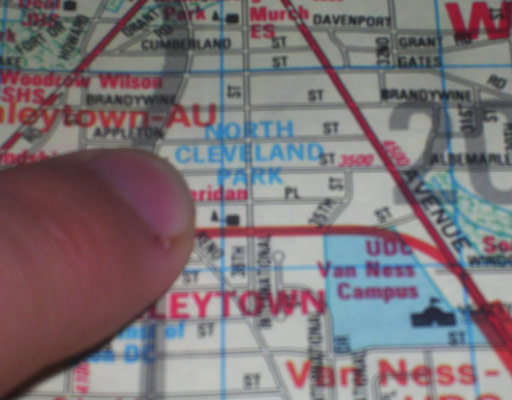
NORTH CLEVELAND PARK: More Proof That It Exists

BACK IN AUGUST 2006, there was a pointless online debate about whether there was actually a neighborhood called North Cleveland Park. While it is commonly called "Van Ness," after the Red Line station, I showed that yes, indeed, North Cleveland Park exists.

Now, more mounting evidence from The Washington Post: D.C. property tax assessments increased by 4.29 percent in North Cleveland Park.

Labels: , , ,